
The 14% Problem: Why Family Bible Reading Is Harder Than We Admit
Written by Ryan Smith, Founder of Stone & Scribe
There is a statistic about family Bible reading that should probably get our attention.
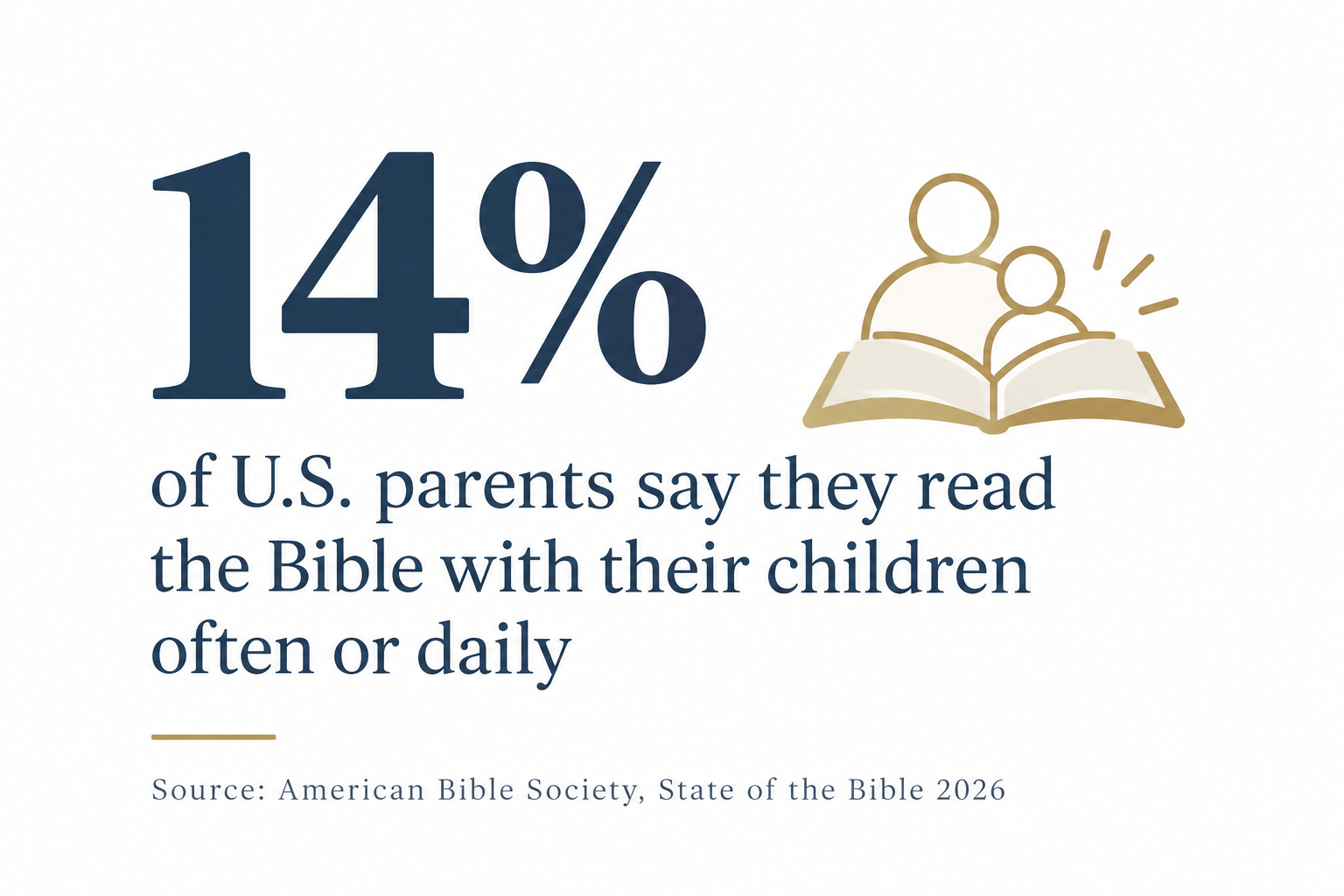
According to the American Bible Society's 2026 State of the Bible research, only 14% of American parents say they read the Bible with their children often or every day.
Sixty-two percent say they rarely or never do.
At first glance, numbers like that can sound like evidence that parents simply aren't taking faith seriously enough.
I don't think that's the most helpful conclusion.
Because when you look a little closer, something more complicated is happening.
Parents are busy. They're tired. They're managing work, meals, homework, sports, laundry, appointments, bedtimes and a hundred other things that compete for the same small handful of hours.
And many Christian parents genuinely want Scripture to be part of family life.
The problem is that wanting it and knowing how to make it happen consistently are two different things.
Family Bible reading can feel harder than it sounds
"Read the Bible with your kids" sounds simple.
Open the Bible. Read it. Talk about it.
But anyone who has actually tried this with children knows there can be a lot more going on.
Which passage do you read?
How much do you read?
What happens when your child doesn't understand it?
What if they ask a question you can't answer?
What do you do with ancient customs, unfamiliar geography or difficult passages?
What if one child loves reading and another would rather be doing almost anything else?
And perhaps the biggest question:
How do you keep Bible time from becoming one more thing kids feel they have to complete?
These aren't signs that a parent is failing.
They're normal challenges that come with introducing children to a collection of ancient books written across centuries, cultures, literary genres and historical settings.
The Bible is accessible, but it isn't always simple.
Maybe consistency isn't the only problem
When family Bible reading isn't working, our instinct is often to focus on discipline.
We need to do it more often.
Set a schedule.
Make a reading plan.
Don't miss a day.
There is certainly value in consistency.
But sometimes the issue isn't simply how often we're opening the Bible.
It's what happens once we open it.
If Bible reading consistently feels like an assignment, children can learn to associate Scripture with finishing something rather than discovering something.
Read the verses.
Answer the questions.
Find the lesson.
Done.
But the Bible contains kings and fishermen, wars and journeys, poetry and prophecy, political intrigue, ancient cities, family conflict, courage, betrayal, miracles, questions, failure and redemption.
There is an extraordinary world inside Scripture.
Sometimes kids just need permission to explore it.
Questions are not interruptions
One of the simplest ways to change family Bible reading is to become less concerned about getting through the passage and more interested in what children notice along the way.
A child asks:
"How far did they have to walk?"
"Why was that person afraid?"
"Where is that city?"
"What did their house look like?"
"Why did God let that happen?"
"Did people really do that?"
Our natural response can be to answer quickly so we can keep reading.
But those questions may actually be the most valuable part of the experience.
Curiosity is evidence that the child is engaging with what they are reading.
You don't have to know every answer.
Sometimes the best response is simply:
"I don't know. Let's find out."
Now Bible reading has become investigation.
Open a map.
Look up the historical setting.
Find another passage.
Check a Bible dictionary.
Talk about what we know and what we don't.
That kind of exploration can help a child begin to understand that reading Scripture isn't about racing toward the correct answer.
It is something worth paying attention to.
Make the goal smaller
Family Bible reading also doesn't need to become a miniature church service at the kitchen table.
You don't necessarily need a 30-minute devotional.
You don't need a prepared lesson.
You don't need three discussion questions and a craft.
Sometimes five thoughtful minutes are better than twenty frustrated ones.
Read a short passage.
Then ask one good question:
What did you notice?
Not "What was the lesson?"
Not "What were you supposed to learn?"
Just:
What did you notice?
You may be surprised where the conversation goes.
Give the story somewhere to live
Context can also make a significant difference, especially as kids move beyond illustrated children's Bibles.
Show them where the story happened.
Talk about how far people travelled.
Look at what people ate, wore and lived in.
Explain who ruled the region.
Find pictures of archaeological sites.
Compare the geography to somewhere they know.
None of this replaces Scripture.
It helps children understand the world in which Scripture actually happened.
Jerusalem stops being a Bible-word and becomes a city.
The wilderness becomes terrain.
A journey becomes distance.
An empire becomes political reality.
The story gains texture.
Let faith happen outside "Bible time"
There is another possibility worth considering.
Maybe some of the most meaningful family discipleship doesn't happen during a formally scheduled devotional at all.

It happens in the car when a child asks a strange theological question.
It happens after church when something from the sermon doesn't make sense.
It happens at dinner.
On a walk.
During a difficult conversation.
At bedtime.
While looking at the stars.
Deuteronomy 6 paints a picture of faith being talked about while sitting at home, walking along the road, lying down and getting up.
Faith woven through ordinary life.
That doesn't make intentional Bible reading unnecessary.
It takes some of the pressure off believing that every meaningful spiritual conversation has to happen during a perfectly organized family devotional.
The answer to 14% probably isn't guilt
The American Bible Society's research also found that parents report significant pressures around work-family balance and exhaustion. At the same time, many remain open to Scripture and want support in raising their children spiritually.
That matters.
If parents already believe they should be reading the Bible with their children, reminding them harder probably isn't the solution.
Maybe we need to make family Bible engagement feel more possible.
Shorter.
More conversational.
More curious.
Less dependent on parents having every answer.
More connected to the child's actual questions.
And more comfortable with the idea that sometimes a five-minute conversation about one strange detail in a Bible story can be more meaningful than finishing three chapters because the reading plan said we should.
Fourteen percent is certainly a number worth paying attention to.
But perhaps the better question isn't:
Why aren't parents trying harder?
Maybe it's:
How can we help families discover a way of exploring Scripture together that they actually want to return to?
That feels like a much more interesting problem to solve.
Source
American Bible Society, State of the Bible: USA 2026, Parenting With the Bible. The study reports that 14% of parents read the Bible with their children often or daily.