

How to Choose a Bible Translation for Kids: A Practical Guide for Parents
Written by Ryan Smith, Founder of Stone & Scribe
Walk into a Christian bookstore or search for a children's Bible online and you can quickly end up with more choices than answers.
NIV. NLT. ESV. CSB. NKJV. NRSVUE Study Bible. Journaling Bible. Student Bible. Children's Bible.
Then come the opinions about which translation is the most accurate, the easiest to understand, the best for memorization, or the one children should supposedly be reading.
For a parent who simply wants to put a good Bible into a child's hands, it can become unnecessarily complicated.
The good news is that you probably do not need to identify one universally "best" Bible translation for kids. A better question is:
Which translation will help this particular child read, understand, and keep engaging with Scripture?
That question is much more useful.
Start with how your child will actually use the Bible
Before comparing translations, think about the job you need this Bible to do.
Will your child primarily read independently? Will you read together as a family? Will they bring it to church and follow along with a teacher? Will it be used for homeschool research? Are you hoping they can grow into it for several years?
Those situations may lead to different choices.
A strong independent reader might be perfectly comfortable with more formal sentence structures. Another child of the same age may understand the story far better when it is expressed in more contemporary English.
Neither child is doing Bible reading "better."
The goal is not to choose the translation that sounds most impressive on the shelf. It is to choose one that fits the reader who will actually be opening it.
Understand translation approaches without turning them into teams
The Bible was written primarily in Hebrew, Aramaic, and Greek, which means every English Bible involves translation decisions.
Some translations place greater emphasis on preserving the wording and structure of the original languages wherever English allows it. Others place greater emphasis on expressing the meaning in natural contemporary English.
You may hear these approaches described with terms such as formal equivalence, functional equivalence, word-for-word, thought-for-thought, or similar labels.
Those terms can be useful, but they can also make translation sound like two opposing camps when reality is more nuanced. Even translations that emphasize literal wording must adjust grammar and idioms to make sense in English. Translations that prioritize natural English still pay careful attention to the original texts.
The publishers themselves describe these priorities differently. Crossway calls the ESV "essentially literal," while Tyndale explains that the NLT uses more dynamic wording when a literal rendering would be difficult or misleading. Biblica describes the NIV as seeking both precision and natural English, while the CSB describes its approach as "optimal equivalence," balancing linguistic precision and readability.
For parents, the important point is simpler:
Different translations make different choices about how best to carry an ancient text into understandable English.
You do not have to turn those differences into a competition.
A practical look at several common translations
Instead of ranking these from best to worst, it is more helpful to ask what you are likely to notice when reading them.
Translation | General approach | What a parent may notice |
|---|---|---|
NLT | Strong emphasis on clear, natural contemporary English | Often flows easily for independent reading and reading aloud |
NIV | Seeks a balance between precision and natural English | Familiar middle ground for many families and churches |
CSB | Uses what its translators call "optimal equivalence" | Generally contemporary while retaining more formal wording where possible |
ESV | Describes itself as "essentially literal" | Often retains more of the structure and terminology of the underlying text |
NKJV | Updates the language of the King James tradition | Retains a more traditional literary feel without many of the KJV's archaic pronouns and verb forms |
NRSVue | Emphasizes accuracy, readability, and current biblical scholarship | Common in academic, ecumenical, worship, and study settings |
These descriptions come from the stated translation philosophies of the versions themselves, not from a ranking of their theological value. The NRSVue, for example, describes its goal as providing a readable and accurate translation informed by updated textual scholarship, while the NKJV was designed to preserve much of the King James tradition while updating older English usage.
There are other respected English translations too. This is not meant to be an exhaustive list.
The point is to give parents a starting place for comparison.
Do not choose based on a reading-level number alone
You will sometimes see charts online assigning Bible translations to specific school grades.
Those numbers can look wonderfully precise, but I would treat them as a starting point rather than a verdict about what your child should read.
Children of the same age can have very different vocabulary, reading confidence, attention, familiarity with Scripture, and tolerance for complex sentences.
There is also a difference between being able to pronounce the words and actually understanding the passage.
A much better test is wonderfully low-tech:
Give the Bible to your child.
Let them read it.
Then listen.
Try the same passage in two or three translations
If you are deciding between a few translations, compare them with your child rather than choosing entirely on their behalf.
Pick two or three versions and use the same passages in each.
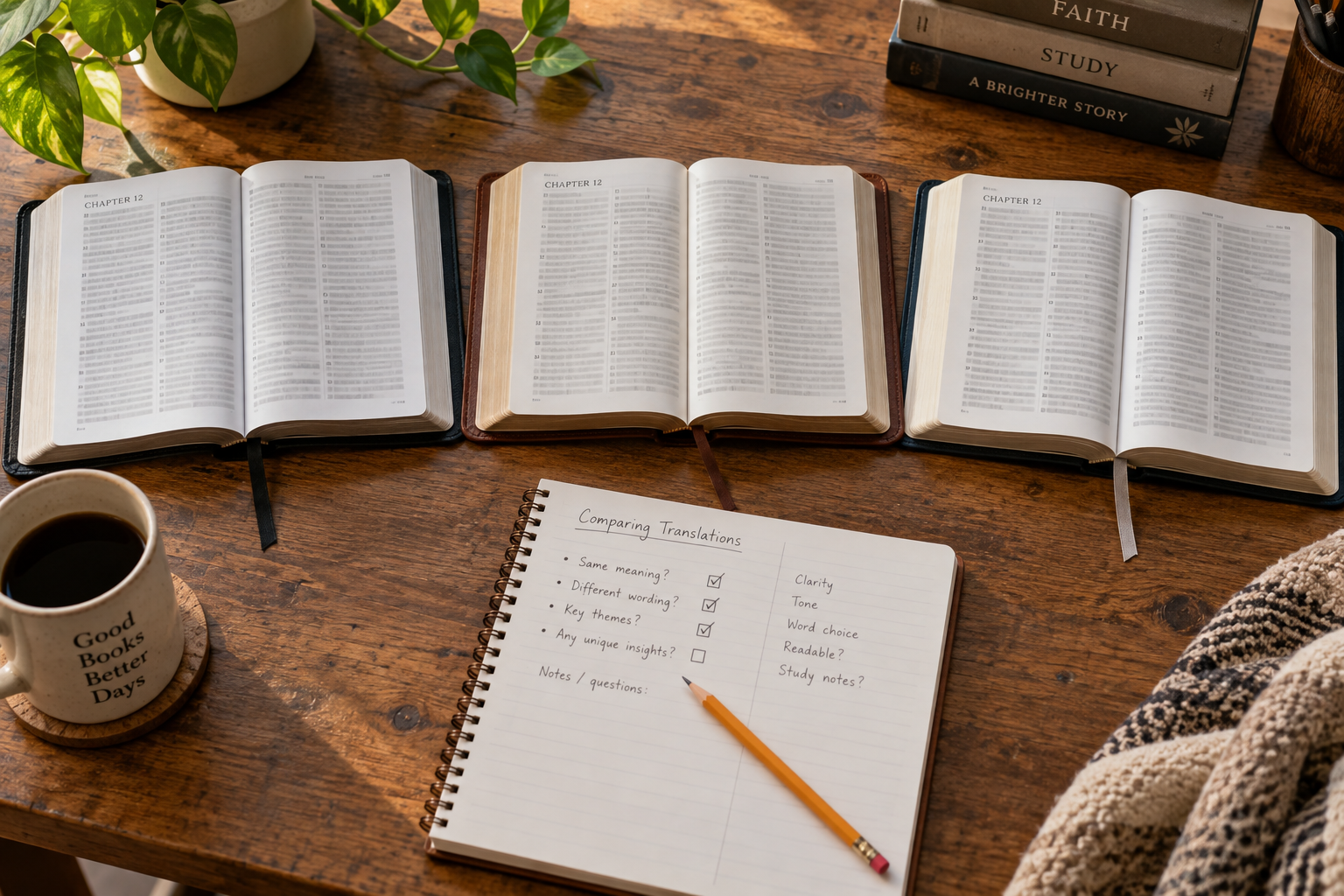
I would try three different kinds of biblical writing:
A narrative passage, such as part of Mark or Acts
A poetic passage, such as a Psalm
A teaching passage, such as part of James
Let your child read a short section from each translation aloud.
Then ask simple questions:
"What do you think that was saying?"
"Were there any words you didn't understand?"
"Which one sounded most natural to you?"
"Did one make the story easier to picture?"
Do not tell them in advance which translation you prefer. You are trying to observe how they interact with the language.
You may discover that the Bible you assumed was easiest still contains phrases that trip them up, while another translation feels immediately understandable.
That information is far more useful than an online ranking.
Pay attention to the Bible they hear at church
There is also value in familiarity.
If your church, children's ministry, or family normally uses one translation, having the same version can make it easier for a child to follow along, recognize passages, and participate in group reading.
That does not mean they must use the same translation at home.
Some families may prefer a more accessible translation for independent reading while children hear another version during church services. Others may value keeping the wording consistent across both settings.
Either approach can work.
The important thing is to consider the child's actual environment rather than choosing a Bible in isolation.
The edition matters almost as much as the translation
There is another part of this decision that is easy to overlook.
You are not only choosing a translation.
You are choosing a physical or digital reading experience.
Two Bibles containing exactly the same translation can feel completely different to a child.

Look at things such as:
font size
page layout
paragraph spacing
maps
timelines
book introductions
illustrations
cross-references
study notes
room for writing
overall size and weight
durability
audio availability
A thick study Bible packed with tiny notes may be incredibly useful for research but intimidating for everyday reading. A beautifully designed Bible with comfortable type and helpful maps might be opened far more often.
Audio can matter too. A child who struggles with sustained independent reading may enjoy listening while following the printed text. That still gives them direct contact with Scripture while reducing some of the friction that can come from decoding every sentence alone.
This is where the question becomes less about abstract translation philosophy and more about the actual child in front of you.
Be careful not to confuse complexity with depth
Parents sometimes worry that choosing more accessible language somehow makes Scripture less serious.
The opposite assumption can happen too. A translation that uses more formal language can be dismissed simply because a child has to work harder to understand it.
Neither shortcut is particularly helpful.
Sometimes a difficult sentence contains an important idea worth slowing down to understand. Sometimes the difficulty comes mainly from unfamiliar English phrasing.
Those are not the same thing.
A useful Bible should occasionally stretch a child. It should not make basic comprehension a constant obstacle.
The sweet spot will differ from one reader to another.
Your child's first "real Bible" does not have to be their forever Bible
There can be a lot of pressure around purchasing a child's first full Bible.
We sometimes treat it like we are choosing the Bible they will carry for the next twenty years.
You are not.
A Bible that is a great fit at nine may not be the one they prefer at fifteen or twenty-five.
That is okay.
Children grow as readers. Their vocabulary expands. Their questions change. They may become interested in deeper study or begin comparing translations on their own.
Choosing something they can meaningfully engage with now is not lowering the bar.
It gives them somewhere to begin.
Using more than one translation can be helpful
There is also no rule saying a family must commit to a single translation and never look at another one.
Comparing translations can actually become a useful Bible-reading habit.
When a sentence seems confusing, read it in another translation and ask what changed. Notice which words stayed similar. Look at where translators made different choices.
That can lead to useful conversations about language without requiring parents or children to know Greek or Hebrew.
It also helps kids understand something important:
An English Bible is a translation of ancient texts, and careful translators sometimes make different decisions about how best to express the same idea.
That realization can encourage closer reading rather than less confidence.
A simple way to make the decision
If you are standing in front of six possible Bibles and still have no idea what to choose, simplify the process.
Step 1: Start with the translation your child already knows
If your family or church regularly uses one translation, include it in the comparison.
Step 2: Add one or two alternatives
Choose at least one version with somewhat more conversational contemporary English and, if useful, one with a more formal style.
Step 3: Test real passages
Do not judge by the cover or marketing description. Have your child actually read from them.
Step 4: Ask them what they understood
Comprehension matters more than whether the translation sounds impressive to an adult.
Step 5: Look at the edition itself
Check font size, maps, notes, layout, weight, and anything else that will affect whether your child enjoys using it.
Step 6: Choose, and stop worrying about finding the perfect one
You are not making an irreversible theological decision.
You are helping a child read the Bible.
The best choice is the one that helps them keep reading
Parents can spend a surprising amount of time debating which Bible belongs in a child's hands.
Translation philosophy matters. Accuracy matters. Readability matters.
But there is also a very ordinary reality worth remembering.
The Bible sitting unopened on the shelf is not helping your child engage Scripture.
Choose thoughtfully. Compare a few translations. Listen to your child read. Pay attention to what they understand. Consider what they hear at church and what will actually make the Bible comfortable to use.
Then give them permission to grow.
The goal is not to find the only Bible translation a child should ever read.
It is to help them develop enough confidence, curiosity, and familiarity with Scripture that they keep opening it.
SOURCES
About the NIV Bible Translation
Biblica
Explains the NIV's stated goal of combining accuracy to the original languages with natural, readable English.
NIV translation philosophy
Translation Process: New Living Translation
Tyndale House Publishers
Explains how the NLT uses both more literal and more dynamic renderings, depending on what communicates the original meaning clearly in English.
NLT translation process
Translation Philosophy: English Standard Version
Crossway
Describes the ESV's "essentially literal" philosophy and emphasis on transparency to the wording and structure of the original texts.
ESV translation philosophy
Christian Standard Bible Translation Philosophy
Holman Bible Publishers
Describes the CSB's "optimal equivalence" approach, intended to balance linguistic precision with contemporary readability.
The New Revised Standard Version Updated Edition
Friendship Press
Explains the NRSVue's goals of accuracy, readability, accessibility, and incorporation of current textual scholarship.
About the NRSVue
What Is the King James Version of the Bible? History and Influence of the KJV
Bible Gateway
Includes background on the NKJV's effort to retain the King James tradition while updating archaic English.