
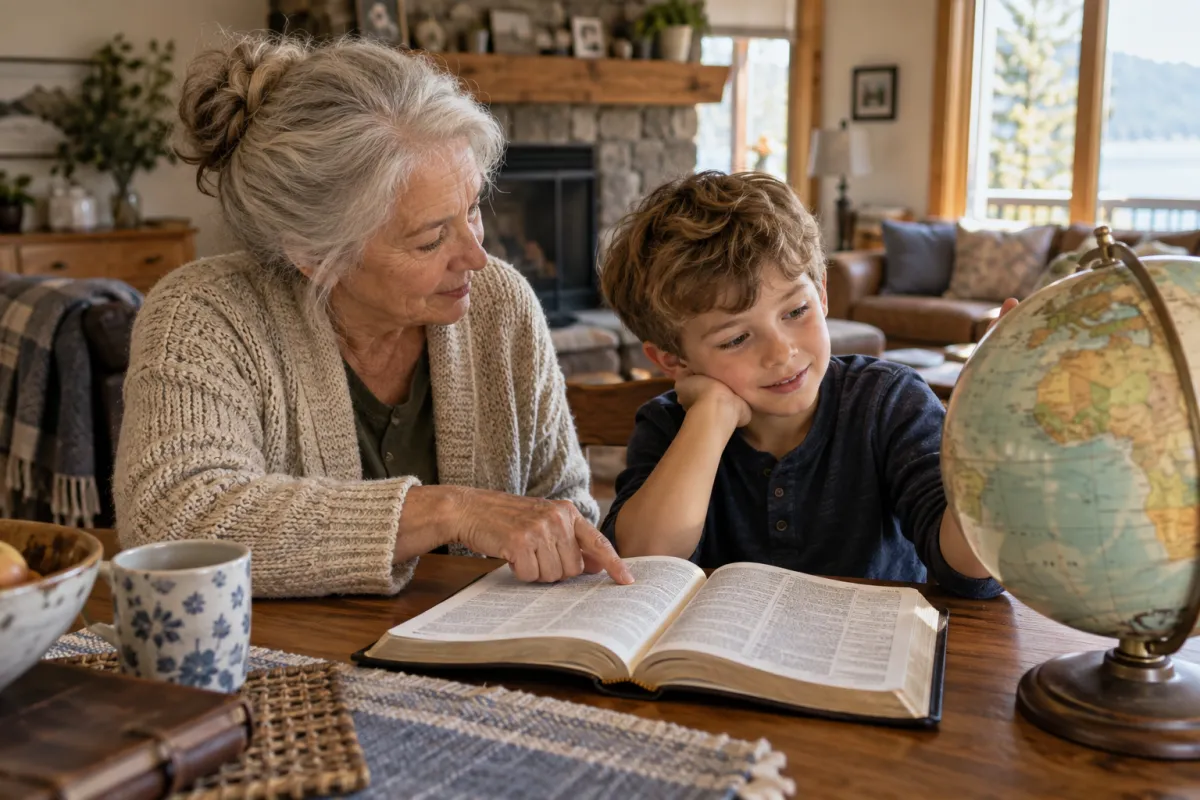
How to Raise Kids Who See the Bible as a World to Explore, Not a Subject to Finish
Written by Ryan Smith, Founder of Stone & Scribe
There is a subtle difference between asking a child to finish something and inviting them to explore it.
We often approach learning with completion in mind. Finish the chapter. Answer the questions. Complete the lesson. There is nothing inherently wrong with that. Structure matters, reading matters, and learning usually requires some effort.
But when Scripture is presented mainly as something to complete, children can begin to approach the Bible the same way they approach an assignment. Get through it, find the answer, move on.
What if we helped them see something different? What if the Bible felt less like a subject to finish and more like a world worth exploring?
Curiosity changes the reason a child keeps reading
Curiosity is not just a personality trait reserved for naturally inquisitive kids. It is part of how people seek information, solve problems, and make sense of the world around them.
A 2025 study involving children ages 10 to 12 found that children remembered trivia facts better when they were more curious about the answer. Greater curiosity was also associated with a stronger desire to keep exploring the topic afterward.
That does not mean every Bible passage needs to become a game or a mystery. It does suggest something important: wanting to know can change the experience of learning.
Consider the difference between saying, "Today we're going to read Judges 6," and asking, "Gideon is hiding when we first meet him. Why would the person God is about to call a mighty warrior be hiding?"
It is the same chapter, but a very different invitation. One tells the child what to read. The other gives them something to look for.
Start with a question instead of an explanation
Adults naturally want to make things easier for children. We explain the background, introduce the story, identify the lesson, and then begin reading. Sometimes that is exactly what a child needs.
But sometimes we answer the question before the child has had a chance to wonder about it.
Research on children's learning has shown that question-asking is one of the ways children actively direct their own learning. Their questions are not simply interruptions. They are often evidence that the child is trying to close a gap in their understanding.
So try reversing the order once in a while.
Instead of beginning with, "Jericho was a fortified city with walls," ask, "Why do you think the walls of Jericho mattered so much?"
Instead of explaining that David was smaller and less equipped than Goliath, ask, "If you were standing in that valley, what would make Goliath frightening before he ever said a word?"
Instead of telling a child how extensively Paul travelled, ask, "How far do you think Paul actually travelled without cars or airplanes?"
Questions create openings. The child now has a reason to investigate.
Let them notice the strange things
The Bible is full of details adults often learn to skim past. Ancient currencies, unfamiliar cities, genealogies, dreams, kings whose empires no longer exist, journeys described in a single sentence, and customs that feel completely foreign to modern readers.
Children often notice those details precisely because they have not yet learned which parts they are supposedly meant to ignore.
That can be incredibly useful.
When a child asks, "What's an ephod?" or "How big is a cubit?" or "Why did they tear their clothes?" you do not necessarily need to redirect them toward the "main point" of the passage.
Sometimes the strange detail is the doorway.
Look it up together. Find the map. Measure the distance. Compare translations. Look at the terrain. Ask what historians know and what remains uncertain.
The goal is not to turn Bible reading into trivia. It is to help children realize that Scripture rewards attention.
Give them permission not to know
One of the fastest ways to shut down exploration is to make every question feel like a test.
If children believe the adult already knows the answer and is simply waiting for them to say the correct thing, curiosity can disappear very quickly.
Sometimes the healthiest three words a parent can say are, "I don't know."
Followed by, "Let's find out."
That changes the relationship. Parent and child are no longer examiner and student. They are investigators.
You may discover that scholars disagree about a location. You may find that a traditional image of a Bible story does not quite match what the text actually says. You may uncover details neither of you had noticed before.
That is not a problem. Learning to distinguish between what Scripture clearly says, what history suggests, and what we simply do not know is a valuable skill.
Use the world around the text
The Bible did not happen on a blank page. It happened among mountains, deserts, rivers, cities, empires, roads, farms, and villages.
People travelled. Armies moved. Weather mattered. Water mattered. Politics mattered. Distance mattered.
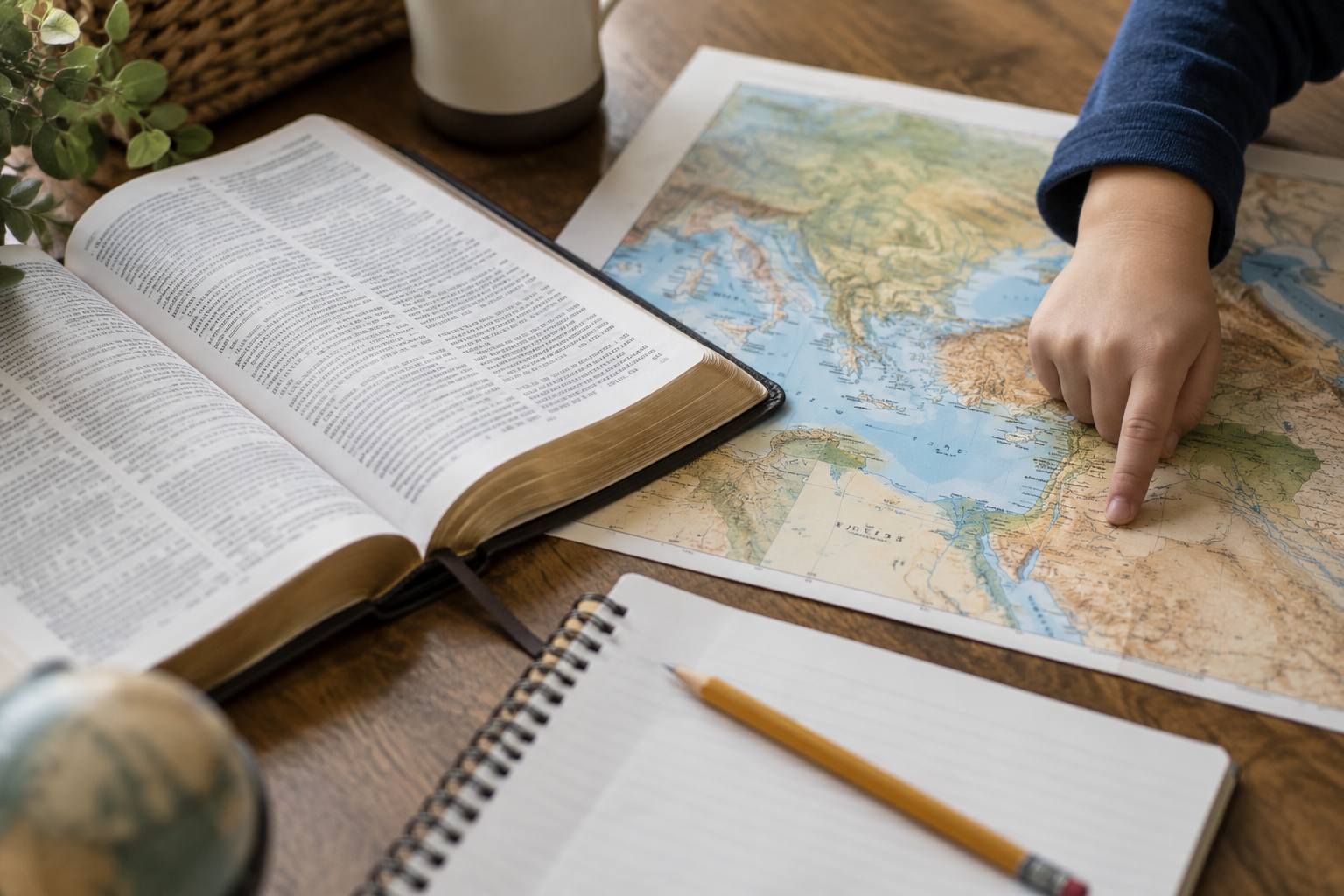
When children begin to understand some of that surrounding world, familiar stories often become more concrete.
Open a map. Measure a journey. Look at photographs of the Judean wilderness. Find out what people ate, what their houses may have looked like, or what kinds of occupations existed in the region.
None of that replaces Scripture. It helps give the words somewhere to live.
Jerusalem becomes a city instead of just a Bible word. The wilderness becomes terrain. A journey becomes distance. An empire becomes a political reality.
Don't rush to the moral
One habit adults often bring to children's Bible teaching is moving quickly from story to lesson.
David defeated Goliath, so be courageous. Daniel prayed, so remember to pray. Joseph forgave his brothers, so forgive people.
Those applications can certainly have value, but if we jump there too quickly, complicated biblical people can become flattened into simple examples.
Before asking, "What should we learn from this?" try asking, "What actually happened here?"
Who made what decision? What changed? What seems surprising? What does the text tell us, and what does it leave unexplained?
Observation can come before application.
Sometimes slowing down makes the story deeper.
Exploration does not mean turning Scripture into entertainment
Helping children explore the Bible does not mean every reading session needs props, puzzles, games, or elaborate activities.
Sometimes the most engaging thing you can do is simply read carefully and ask a genuinely interesting question.

Curiosity is not about making Scripture compete with YouTube. It is about helping children recognize that there is actually something worth discovering.
A mystery can help. A map can help. A historical detail can help. A question can help. But none of those things are the destination.
They are invitations back into the text.
Leave some questions open
Adults often feel responsible for wrapping every conversation up neatly.
But good questions sometimes need time.
You can end Bible time by saying, "I don't know why that happened. Let's keep thinking about it," or, "Let's see if another part of the Bible helps us understand that."
Sometimes the best answer is simply, "That's a really good question. I don't think we have enough information to answer it."
An unfinished question can travel with a child. They may remember it later, notice something related in another passage, ask someone else, or go looking for the answer themselves.
That is not a failure to complete the lesson. It may be evidence that the lesson is continuing.
The Bible is something children can grow into
Children do not need to understand everything in Scripture immediately. Neither do adults.
There will always be another connection, another historical detail, another question, another passage that changes the way we understand something we read years earlier.
Perhaps one of the best gifts we can give children is the expectation that the Bible is not something they are supposed to finish. It is something they can return to, investigate, question, and keep discovering for a lifetime.
Maybe the goal is not to raise kids who always know the answer.
Maybe it is to raise kids who believe Scripture is worth opening again because there is still more to find.
Sources
Van Schijndel, T.J.P. & Jansen, B.R.J. Integrating lines of research on children's curiosity-driven learning, Journal of Experimental Child Psychology, 2025.
Ronfard, S. et al. Question-asking in childhood: A review of the literature and a framework for understanding its development, Developmental Review, 2018.