
One Bible Story, Five Subjects: A Simple Cross-Curricular Homeschool Idea
Written by Ryan Smith, Founder of Stone & Scribe
One of the advantages of homeschooling is that subjects do not always have to live in separate boxes. History does not have to stop when geography begins, writing can grow out of something a child has been researching, and art can help them notice details they might otherwise overlook.
The Bible lends itself especially well to this kind of connected learning because its stories already sit inside a larger world of people, places, governments, journeys, languages, architecture, conflict, trade, and culture. That does not mean turning every passage into a school assignment. It simply means recognizing that sometimes one story can naturally open several different doors.
Here is one simple way to do that.
Start with the story itself
Before adding maps, projects, research, or activities, read the passage first and let the story stand on its own. Ask your child what they noticed, what confused them, and what they would want to know more about. You may be surprised by which detail catches their attention.
For example, imagine you are reading about Paul's journey to Rome in Acts 27. An adult might immediately focus on Paul's faith during the storm, while a child may wonder how big the ship was, where they were going, how long the trip took, or what people did during storms before modern weather forecasts existed.
Those questions are not distractions from the story. They can become pathways into it.
1. Geography: Put the story on a map
The easiest place to begin is often geography. Find the locations mentioned in the passage and place them on a map. For Paul's journey, you could locate Caesarea, Crete, Malta, and Rome, then look at the route between them.
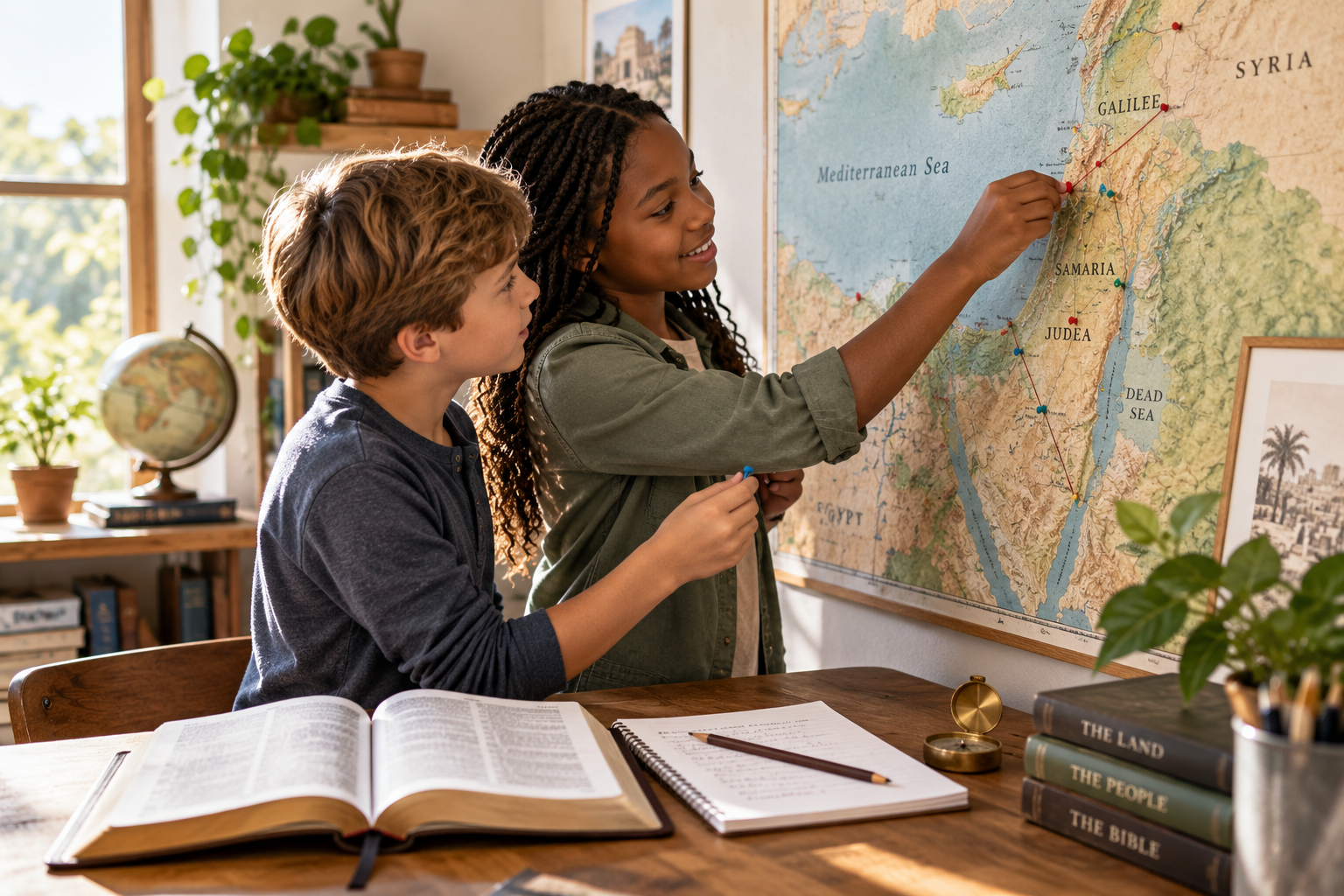
From there, you can ask practical questions. How far did they travel? What bodies of water did they cross? Which direction were they moving? What modern countries would those places be in today?
Even a few minutes with a map can change the way a child pictures a biblical journey. Instead of characters somehow moving from one Bible name to another, they begin to see distance, terrain, coastlines, and actual routes.
If your child enjoys hands-on activities, print the map and trace the journey with coloured pencil, string, or small markers.
2. History: Ask what was happening around the story
Once the place becomes clearer, widen the lens a little. What was happening historically when this story took place? Who controlled the region? What empire was in power? How did ordinary people travel, work, and live?
You do not need to turn this into a university lecture. A few well-chosen questions can be enough to help a child understand the setting.
With Paul's journey, that might lead to a short exploration of the Roman Empire, Mediterranean trade, Roman roads, or how prisoners were transported. With Esther, it could lead into Persia. With Daniel, Babylon. With Joseph, ancient Egypt.
The Bible story begins connecting naturally with history rather than existing in a separate religious category.
3. Writing: Give them something worth writing about
Writing becomes much easier when children actually have something interesting to say.
Instead of asking for a generic paragraph summarizing the story, give them a prompt that requires imagination, observation, or explanation. A child studying Acts 27 might write a journal entry from someone aboard Paul's ship during the storm, explain the journey to someone who has never seen the Mediterranean, or list three things they would want to know before boarding an ancient sailing vessel.
Younger children might write a few sentences. Older children could write a full page and do enough research to make the response historically believable.
The important part is that the writing grows naturally out of what they have already been learning.
4. Art and design: Make the world visible
Art does not always have to mean drawing a Bible character.
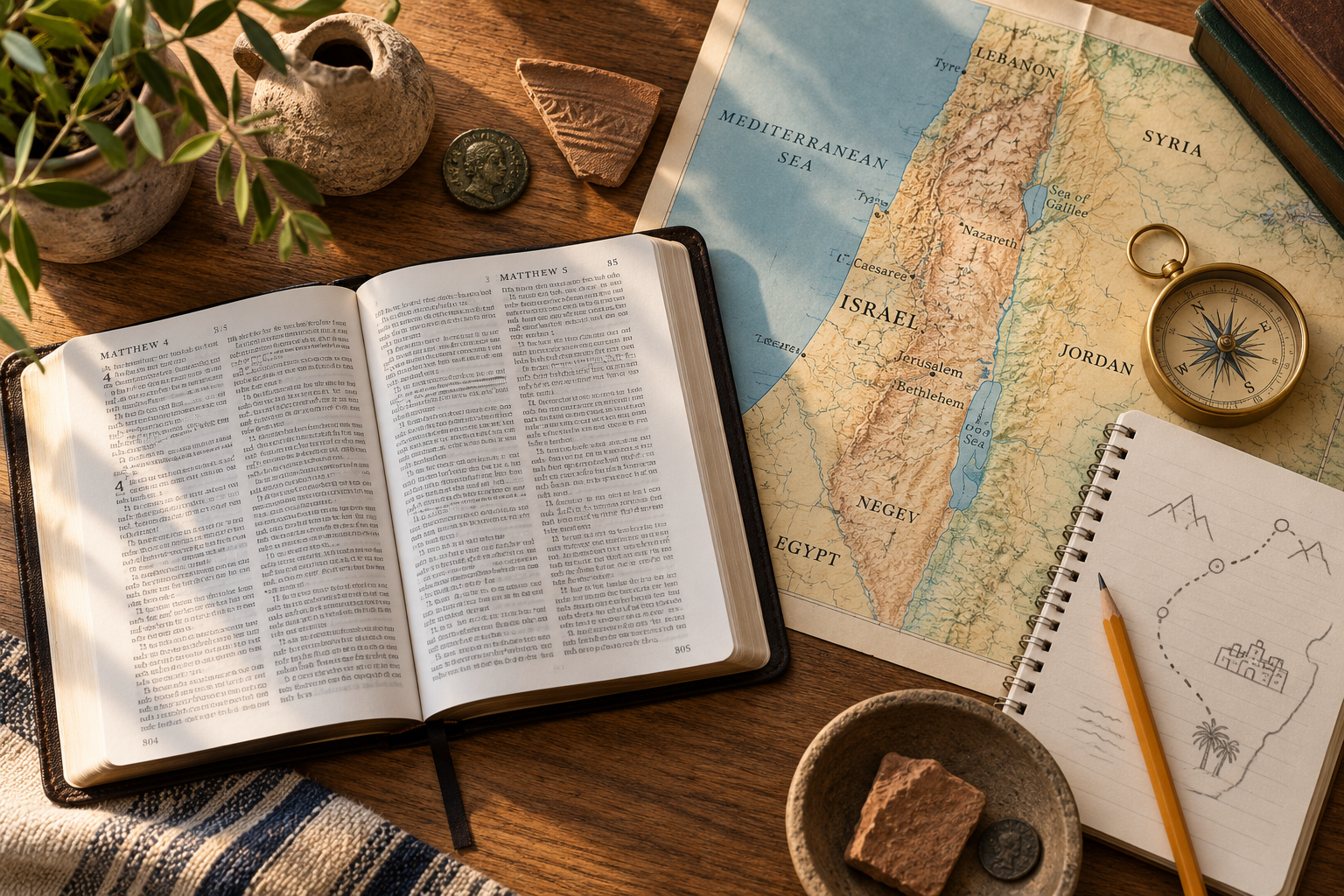
Sometimes it can help children visualize the world surrounding the story. They might sketch the coastline of Paul's journey, create an ancient-style map, draw what they imagine the ship looked like, or make a diagram showing where different people might have been during the storm.
Another child might prefer building something. A simple model, clay map, Roman road, travel journal, or illustrated route can all work.
The finished product matters less than the process of noticing details and translating what they learned into something visible.
5. Research: Let one question lead somewhere unexpected
This may be the most valuable part of the whole exercise.
Instead of assigning every research question yourself, let your child choose one thing they genuinely want to know. Maybe they want to learn how ancient ships worked. Maybe they want to find Malta on Google Earth. Maybe they want to know what people ate on long voyages, how sailors navigated, or what kind of weather the Mediterranean gets.
The question may lead somewhere you did not expect, and that is perfectly fine.
One of the strengths of connected learning is that a single curiosity can lead into weather, engineering, navigation, archaeology, politics, language, or science. You do not always know where the interesting part will be before you begin.
You do not need to do all five
The goal is not to take every Bible story and force five school subjects out of it. That would become exhausting very quickly.
Think of these as options rather than requirements. One week, geography might be enough. Another time, your child may become fascinated with an ancient city and spend several days researching it. Sometimes you will simply read the passage and talk about it, and that is enough too.
The value of cross-curricular learning is not that everything becomes a project. It is that children begin to see connections.
Let your child's curiosity decide where to go deeper
If you already have a carefully planned homeschool schedule, this approach does not need to replace it. It can simply be something you use when a story sparks a question worth following.
Listen for questions like:
Where is that?
Is that a real place?
How did they do that?
How long would that take?
What did that look like?
Why would they go there?
Those are often invitations to explore a little further.
Sometimes the most memorable learning begins with something you had not planned to teach at all.
A simple template you can reuse
The next time a Bible story catches your child's attention, you can use five simple prompts:
Geography: Where did this happen?
History: What was happening in the world at the time?
Writing: What could we explain, imagine, or retell?
Art: What could we draw, map, design, or build?
Research: What are we genuinely curious about?
You do not need elaborate supplies. A Bible, a map, a notebook, and access to a few reliable resources can take you surprisingly far.
Scripture does not have to become another textbook
There is one caution worth keeping in mind. The point of this approach is not to turn Bible reading into another list of assignments.
If every passage ends with a worksheet, project, essay, and quiz, children may begin approaching Scripture primarily as schoolwork. The better goal is to let learning grow out of genuine curiosity when the opportunity appears.
Read the story, notice something, ask a question, and go looking. Sometimes that process will take five minutes. Sometimes it might take the entire afternoon.
Either way, the child begins discovering that the Bible is connected to geography, history, language, culture, and the larger world they are already learning about. That can make both Scripture and homeschool feel less like separate subjects to complete and more like a world worth exploring.