
15 Bible Activities for Kids Ages 8–12 That Go Beyond Worksheets
Written by Ryan Smith, Founder of Stone & Scribe
By the time kids reach the upper elementary years, they are usually ready for more than coloring pages, simple crafts, and fill-in-the-blank worksheets. They are asking better questions, noticing details, solving more complicated problems, and beginning to form their own understanding of what they read.
That makes ages 8–12 a particularly interesting stage for exploring the Bible.
The goal does not have to be making Scripture feel like school, and it does not have to be turning every Bible story into a game. A better approach is to give kids something meaningful to dowith what they are reading. Let them investigate, compare, search, build, map, question, imagine, and discover.
Here are 15 Bible activities designed with that age group in mind.
1. Create a Bible Mystery
Choose a Bible story and turn part of it into a mystery your child has to solve. Instead of immediately telling them the answer, give them three or four clues drawn directly from the passage and let them investigate.
For example, you could ask, “Who am I?” and give clues about a biblical character, or hide the identity of a city, object, or event until they piece the evidence together. Older kids can even create mysteries for parents or siblings to solve afterward.
The important part is requiring them to return to the Bible for evidence. That changes the activity from simple trivia into investigation.
2. Map the Story
Many Bible stories become much easier to understand once kids can see where they happened. Print a simple map of the ancient Near East, Israel, Jerusalem, or the Mediterranean and follow the movement of the story.
Trace Paul’s journeys, locate Bethlehem and Nazareth, follow Israel’s journey out of Egypt, or compare the locations connected to David’s life. Kids can mark locations with symbols, string, stickers, or handwritten notes.
You do not need a perfect historical atlas to get started. The point is to help kids realize that biblical events happened in real places, often separated by significant distances and difficult terrain.
3. Build a Scripture Scavenger Hunt
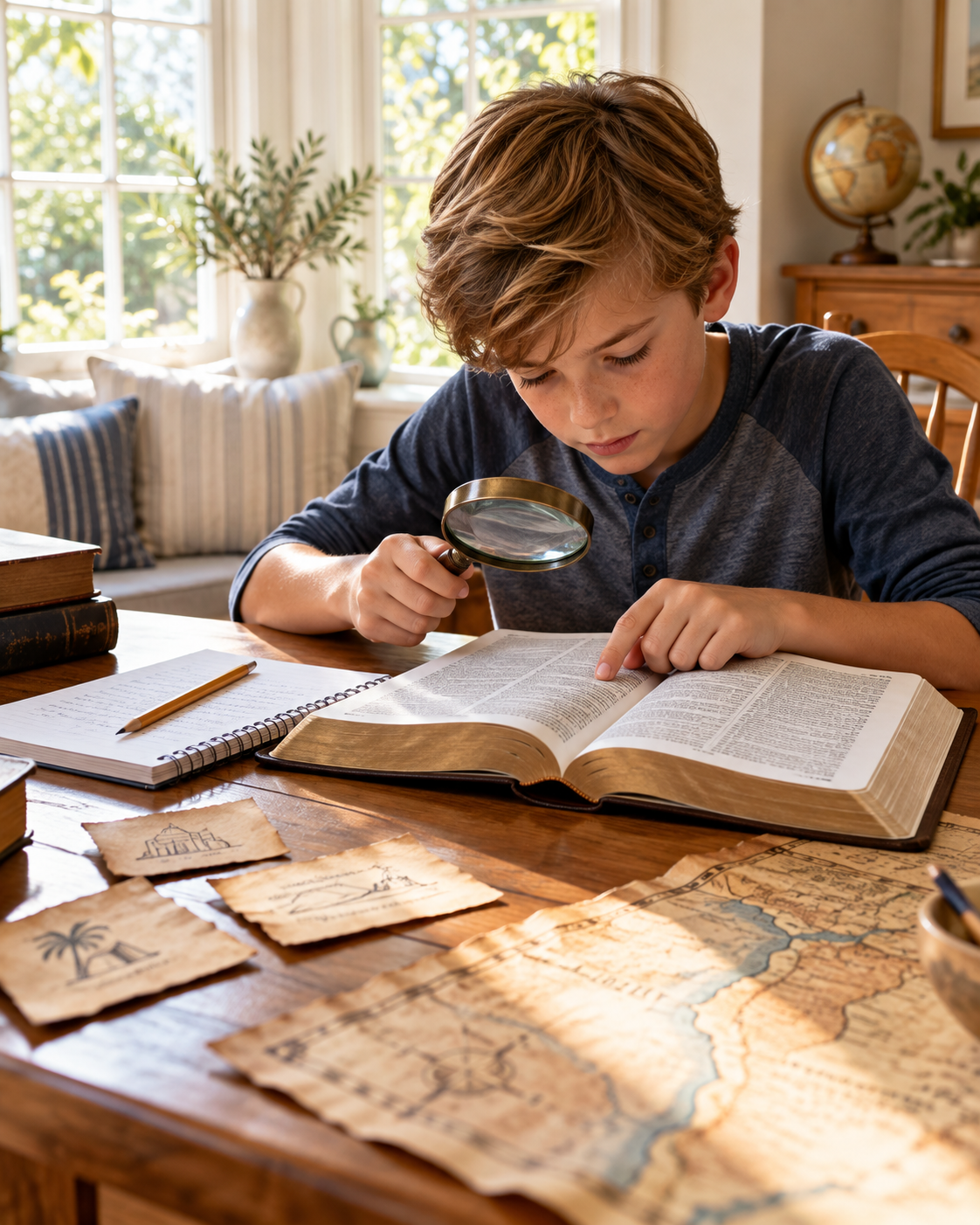
Create a trail of clues that can only be solved by looking up Bible passages. One verse might reveal a person, another might point toward an object, and a third might provide a number or location needed to unlock the next clue.
You can hide clues around the house or simply create the entire hunt on paper. For older children, make the clues less obvious and require them to compare several passages before moving on.
A scavenger hunt is especially useful because kids are not simply answering questions about Scripture. They are using Scripture as the tool that moves the activity forward.
4. Examine a Biblical Object
Choose an object mentioned in the Bible and investigate what it actually was. A sling, oil lamp, scroll, seal, denarius, fishing net, Roman road, clay jar, shepherd’s staff, or piece of armour can open up an entirely different way of looking at a familiar story.
Ask questions such as: What was it made from? Who would have used it? How large was it? Was it common or expensive? What would a child living at that time have known about it?
You can look at museum photographs, archaeological drawings, or historical reconstructions together. Then return to the biblical passage and see whether understanding the object changes how your child pictures the scene.
5. Make a Character Evidence File
Instead of writing a traditional character report, create an investigation file.
Choose someone from Scripture and divide a page into categories such as “What we know,” “What they did,” “Important decisions,” “People connected to them,” “What Scripture actually says,” and “Questions we still have.”
That last category matters. Kids should learn that there is a difference between something the Bible tells us and something we are simply imagining. An evidence file gives them permission to be curious while still keeping Scripture at the centre of the activity.
6. Decode a Secret Message
Codes and ciphers work especially well with this age group because they feel more like a challenge than an assignment.
Write a short Bible verse, location, character name, or important phrase in a simple substitution cipher. Give your child enough information to begin cracking the code, then let them work through the rest.
Once they solve it, have them locate the passage in the Bible and talk about why that verse or phrase mattered in its original story. The decoding provides the hook, but Scripture remains the destination.
7. Compare Two Accounts of the Same Event
Older elementary kids are capable of noticing far more than we sometimes give them credit for.
Choose an event that appears in more than one Gospel and read both accounts. Ask your child to identify what appears in both, what details are unique to each writer, and what questions they have afterward.
The goal is not to make the exercise overly academic. It is simply to teach kids to slow down and notice what the text actually says.
You can do the same thing with events that are referenced elsewhere in Scripture, comparing how different passages contribute to the larger picture.
8. Create a Bible Timeline Challenge
Print or write several major biblical events on separate cards and mix them up. Ask your child to arrange them in the order they think they happened.
Start with obvious events such as Creation, Noah, Abraham, Moses, David, the exile, the birth of Jesus, the crucifixion, and Paul’s missionary journeys. Once those are established, begin inserting less familiar people and events between them.
This helps kids develop a mental framework for Scripture. Instead of experiencing the Bible as a collection of disconnected stories, they begin to see how people and events fit together.
9. Investigate Everyday Life in Bible Times
Choose one ordinary question and see how much you can discover together.
What did people eat? What did children do during the day? How were houses built? What did people wear? How did they travel? What did a marketplace sound like? How long would a journey between two biblical cities have taken?
This is one place where archaeology, geography, history, and Scripture can work together beautifully. The point is not simply collecting ancient facts. It is helping kids picture the human world in which biblical events took place.
10. Put a Bible Character on Trial
This works particularly well with siblings, families, homeschool groups, or church groups.
Choose a controversial decision made by a biblical character and assign different roles. One person can defend the decision, another can challenge it, and others can serve as witnesses using information from the biblical account.
Everyone has to support what they say with evidence from Scripture.
The activity encourages careful reading because kids cannot simply argue from memory. They need to know what the passage actually tells them.
11. Create an Archaeology Table
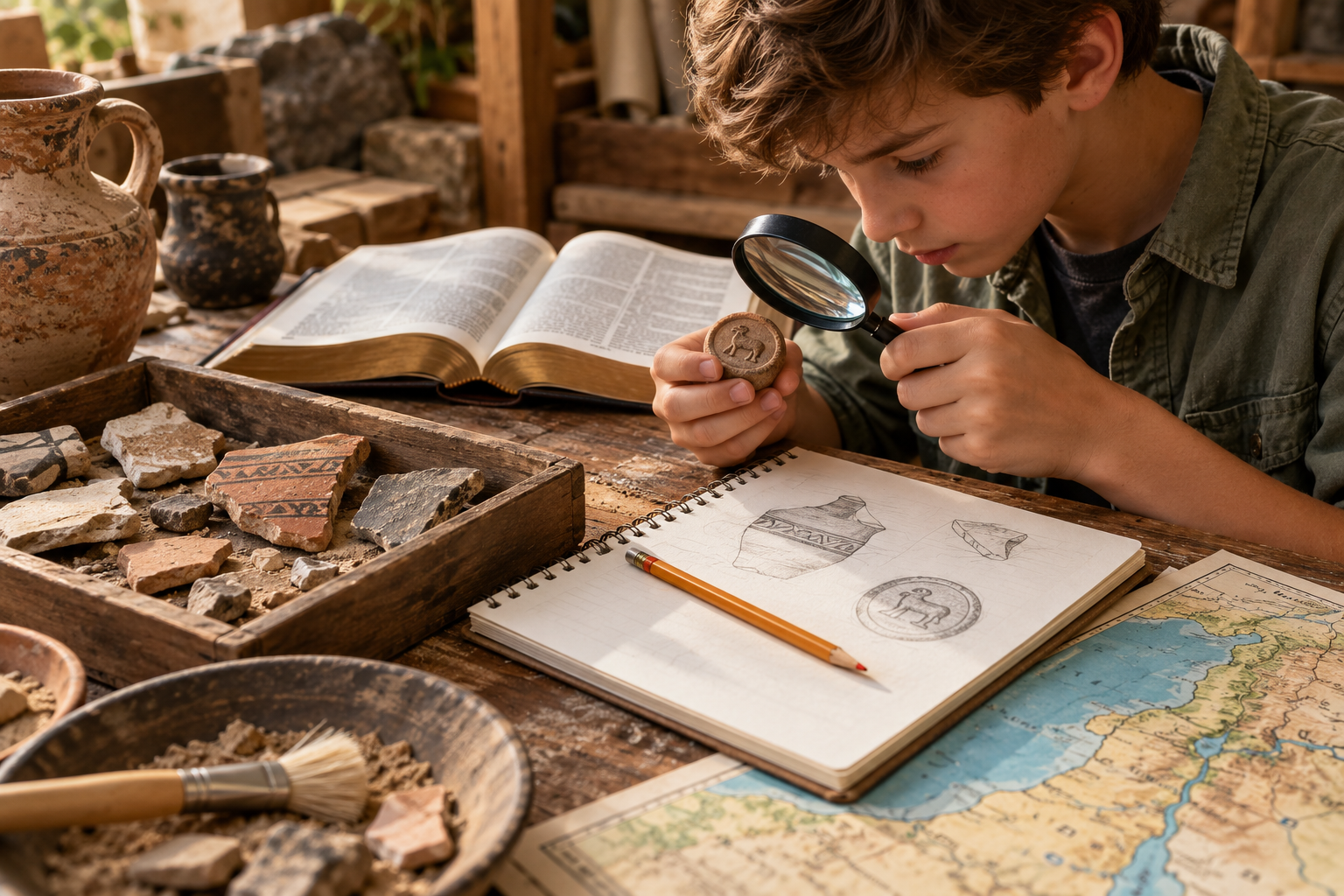
You do not need genuine artifacts to introduce kids to the idea of archaeology.
Gather a few inexpensive or homemade objects that resemble things from the ancient world, such as pottery fragments, coins, pieces of rope, handwritten “scroll” fragments, seals, maps, or small clay objects. Present them without explaining everything immediately.
Ask your child what each object might have been used for, what clues they can observe, and what they would want to know before drawing a conclusion.
Afterward, compare their theories with information about real objects from biblical history. It is a simple way to develop curiosity while showing that understanding the ancient world often involves piecing together evidence.
12. Turn a Passage Into a News Report
Ask your child to imagine that they are a reporter covering a biblical event.
What headline would they write? Who would they interview? What facts are confirmed? What information is still unknown? How might different people present at the event describe what happened?
They can write a short article, record an audio report, or simply give the report aloud.
This works especially well with dramatic narratives, but it can also reveal whether a child actually understands the sequence of events and the people involved.
13. Follow One Word Through Scripture
Choose an important word such as covenant, shepherd, kingdom, wisdom, light, sacrifice, faith, or temple and see where it appears throughout Scripture.
You do not need to complete a complicated word study. Pick three or four passages and ask how the meaning develops or changes depending on the context.
For an 8-year-old, this might simply mean finding repeated ideas. For a 12-year-old, it can become a surprisingly thoughtful discussion about how different parts of the Bible connect.
14. Create a Family Bible Challenge Jar
Write short Bible challenges on slips of paper and place them in a jar. Once or twice a week, draw one.
Challenges might include finding three verses that mention a particular object, identifying five places connected to Jesus’ ministry, locating the shortest book in the New Testament, finding a Psalm connected to a particular emotion, or researching an animal mentioned in Scripture.
Keep the challenges short enough that they remain enjoyable. Ten or fifteen minutes is often plenty.
Over time, the jar becomes an easy way to introduce curiosity without having to plan a full activity every time.
15. Let Kids Become the Investigator
One of the best changes you can make is also one of the simplest: stop providing every question.
Read a passage together and ask your child to come up with the questions instead.
What seems strange? What do they want to know more about? What detail did they notice? What would they ask one of the people in the story? What historical information might help them understand it?
You may be surprised by where the conversation goes.
A child who learns that questions are welcome is much more likely to approach Scripture with curiosity rather than simply waiting for an adult to explain what everything means.
The Goal Is Not More Activities
There is an important distinction here. Kids do not necessarily need more things competing for their attention. They need opportunities to engage more deeply with what they are already learning.
That is why the strongest Bible activities are usually connected directly to Scripture rather than simply borrowing biblical characters or themes. A game can be fun, but the activity becomes more meaningful when solving the puzzle, following the map, examining the evidence, or completing the challenge sends the child back to the biblical text.
This is also part of the thinking behind Stone & Scribe. Kids ages 8–12 follow an unfolding mystery through physical packages, clues, codes, investigations, maps, and challenges, with each investigation ultimately pointing them back toward Scripture.
It is not intended to replace the Bible, family conversations, or church. The goal is much simpler: give kids another reason to become curious about what they are reading.
If your child loves mysteries, puzzles, secret messages, history, or figuring out how things fit together, you can learn more about Stone & Scribe and Start the Adventure.
www.TheStoneAndScribe.com