Before It Reaches the Mailbox: What Goes Into Creating Stone & Scribe
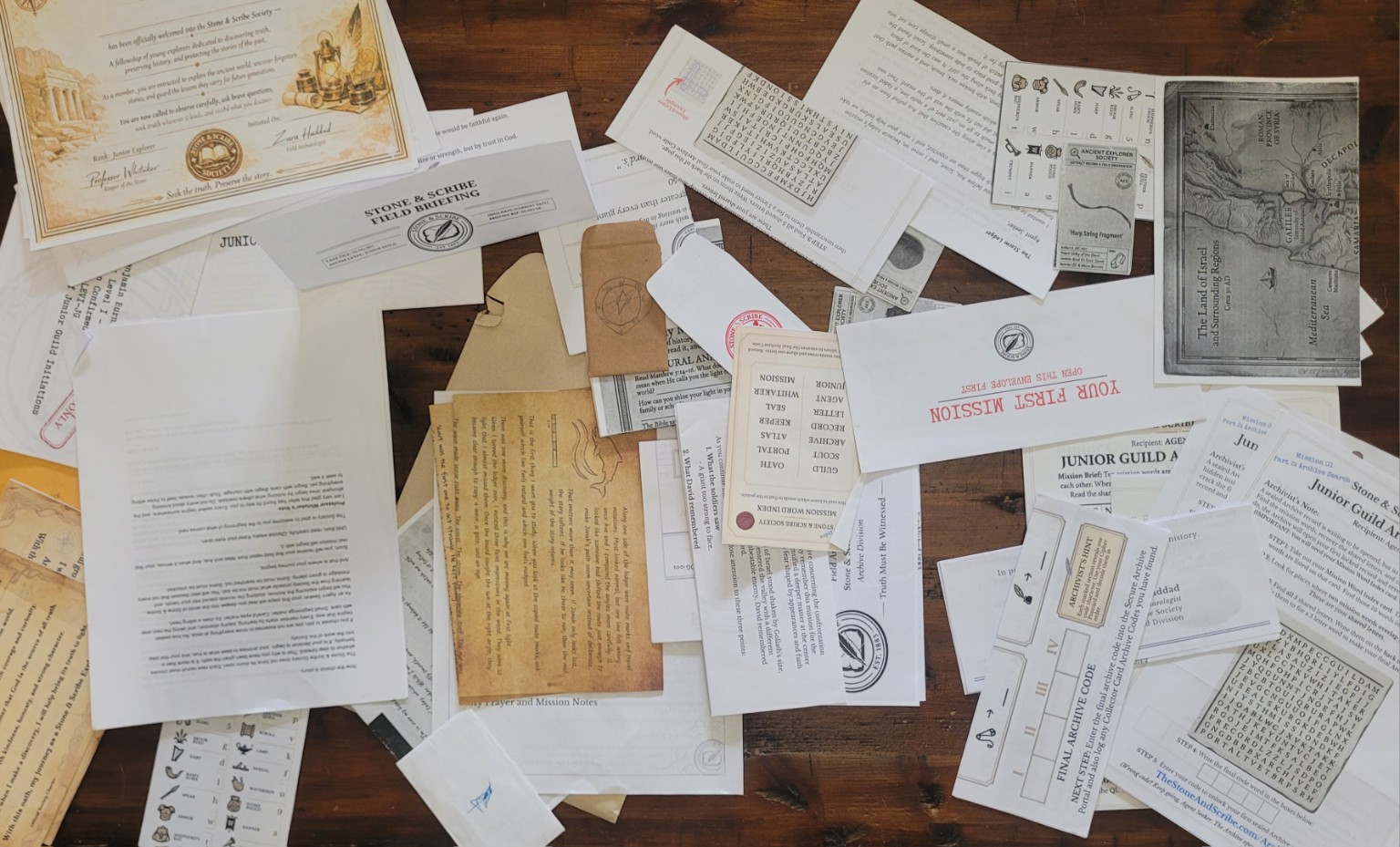
There is a folder sitting near my desk that has become increasingly difficult to close. Inside are early drafts, abandoned puzzle ideas, maps that were redesigned, missions that were rewritten, test prints, envelope experiments, pieces that almost made the cut, and quite a few ideas that seemed much better in my head than they did once I printed them.
And this is only part of the pile.
When someone receives Stone & Scribe in the mail, they see the finished version. A letter arrives addressed to them, there is a mystery to investigate, something to decode, an artifact to examine, and a story that sends them back into the Bible looking for answers. What they do not see is everything that happened before that envelope reached the mailbox.
A Lot of Ideas Never Make It
When I started developing Stone & Scribe, I knew I did not want to simply create another collection of Bible worksheets. There are already plenty of good resources that help kids learn facts, answer questions, memorize verses, and work through Bible lessons.
I wanted to approach it differently. The question I kept coming back to was simple: what would make a kid genuinely curious about what happens next?
That question changed how I approached almost everything. A puzzle could not just exist because puzzles are fun. It had to move the investigation forward. An artifact could not simply look interesting. It needed to feel like something the child had actually discovered.
The same was true of Scripture. I did not want a Bible passage to feel tacked onto the end of an activity. I wanted the passage itself to contain something the investigator needed.
Sometimes an idea worked right away. Most of the time, it did not.
Print It. Test It. Change It.
One of the reasons the pile became so large is that I print things constantly. Something can look perfectly fine on a computer screen and feel completely different once you are actually holding it.
Is the clue obvious enough? Is it too obvious? Can a 10-year-old understand what they are supposed to do without someone explaining it? Does the artifact actually feel like an artifact, or does it still look like something printed from a computer?
Those questions are hard to answer until the idea becomes physical. So I print it, test it, change it, and print it again.
Sometimes I change one sentence. Sometimes an entire investigation gets rebuilt. Occasionally, the best decision is simply to throw the idea away and start over.
The Details Matter
There are a lot of small decisions behind something like Stone & Scribe. What size should a particular piece be? Should this clue arrive in the first mailing or the second? Does the story reveal too much too quickly? Would a handwritten note make more sense than a formal document?
None of those decisions are particularly dramatic on their own, but together they determine whether the experience feels like a pile of activities or an actual adventure.
That is the part I have probably become most particular about. I do not want a child to feel like someone handed them homework wearing an explorer hat. I want them to feel like something has actually arrived for them, and that there is something worth discovering inside.
Scripture Is Part of the Investigation
One of the principles behind Stone & Scribe is that the Bible should not feel like the thing you have to read before you get to the fun part. It should be part of solving the mystery.
That might mean noticing a particular word in a passage, comparing details from a story, identifying something a character said, or finding information that unlocks the next clue. The mystery gives the child a reason to pay closer attention.
Instead of being told, “Read these verses and answer the following questions,” the child is thinking, “There has to be something in here that helps me solve this.”
That change in motivation matters. The goal is not to hide Scripture behind puzzles. It is to give kids another reason to explore it closely.
Most of This Will Never Be Seen
That is what makes looking through this folder a little funny. Most of these pages will never be seen by a Stone & Scribe member.
There are unfinished ideas, outdated versions, wrong turns, redesigned documents, abandoned storylines, and clues that simply were not good enough. But almost every one of them contributed something to the final experience.
An investigation got clearer. A story became stronger. A clue became simpler. An artifact became more believable.
Sometimes figuring out what does not work is exactly what gets you closer to what does.
Before It Reaches the Mailbox
Most people will only ever see the finished envelope. They will not see the drafts, the discarded ideas, the puzzles that did not work, the test prints, or the versions that were almost right.
And that is kind of the point.
All of that work happens beforehand so that when a kid finally opens the envelope, none of it feels like work. It just feels like an adventure.